

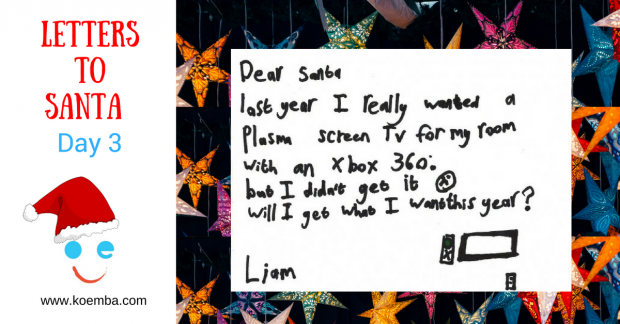
Dear Santa
Today a mother is asking how to deal with children’s emotions when she’s dealing with ‘wants’ versus ‘needs’. And even children are worried about disappointment – see Liam’s letter.
What can parents do when they are dealing with a child’s disappointment?
PercyPostElf
Dear PercyPostElf
Sometimes when children have a big ’want’ it can feel like a ‘need’.
Parents hate to see their children disappointed. They love their kids so much that they forget that disappointment is part of the fabric of life. Preventing children from ever feeling reasonable disappointment is like keeping a plant in a hot-house, it’ll never cope with being exposed to the storms of life.
Some parents will have disappointed children this Christmas. Here’s what I’ve learnt about ‘whole-brain’ parenting and disappointment. When a strong emotion is triggered, the brain goes on ‘red alert – survival mode’ and the reasoning part of the brain temporarily ‘shuts down’. Reason-able behaviour often disappears because we are not able to reason – the thinking part of the brain isn’t fully functional when we are emotionally flooded.
What doesn’t help when a child is emotionally flooded?
1. Don’t be-little.
( ‘Big boys don’t cry!’ ‘Oh grow up!’)
2. Don’t compare.
( ‘Your sister’s happy with what she’s got.’ ‘I didn’t get anything like you’ve got when I was little.’)
3. Don’t try to reason while the child’s emotionally overwhelmed.
(Your child can’t hear comments like ‘But we can’t afford it,’ whilst he is upset.)
4. Don’t ignore the child or his feelings.
(Upset feelings don’t just go away by themselves, even if they go underground. They need a space to be heard and validated).
5. Don’t redirect.
( ‘Oh, let’s play with your other toys.’) Parents sometimes think this is helpful, but it’s a subtle way of ignoring the child’s experience.
Tips for parents when a child’s disappointed:
TIP #1. Help your child to Name, Claim and Tame this emotion.
When you name the child’s experience, he can claim it (realise that’s his emotion!). When he can claim the emotion he can tame it. (He can learn to accept his disappointment without it overwhelming him.)
TIP #2. Listen to his disappointment, without trying to ‘fix’ it.
‘You’re disappointed that you didn’t get *** for Christmas. Tell me more.’
Give the space to share how it is for him, just accepting his emotion without trying to change anything. Remember his behaviour is about him – your response is about you. When you’re safe and connected – he can express disappointment.
.TIP #3. Validate how it is for him.
‘’And that makes sense because you would really have liked …’
Validation doesn’t mean that you agree with him – you’re just acknowledging his perspective. It also doesn’t mean we have to ‘make it better’. Sometimes tears might flow. Just stay connected. The tears we cry when we’re emotionally upset are chemically different to the tears we cry when we’re peeling an onion. So there’s wisdom in the expressions: ‘Have a good cry’ ‘Cry it all out.’ (And of course, the same goes for girls too).
‘Children whose feelings and experiences are validated may cry more or they may become angrier precisely because your validation gives them permission to express their deepest feelings. Once they have done, however, they often move on with no residue of bad feelings.‘ Aldort 2006

So if you are dealing with your child’s disappointment, be there for them. You don’t have to feel guilty, rush off to the toy store or wave a magic wand. Just connect.
For more thoughts see “3 Traps Parents Fall Into When a Child Is Disappointed”
For more insights about how to deal with children’s challenging behaviours this Christmas, see Val Mullally’s book: ‘BEHAVE – What To Do When Your Child Won’t.
I’m looking forward to other questions from parents.
Love
Santa
P.S. Here are my other letters:
Day 1 What to do with Children’s ‘Great Expectations’?
Day 2 ‘Need’ or ‘Want’
Day 4 Christmas Surprises
Day 5 Three Key Questions Regarding Purchases
Day 6 No Money This Christmas
Day 7 Christmas is for Giving
Day 8 When Sad or Bad Things Happen at Christmas
Day 9 When Grown Ups Fight
Day 10 An Attitude of Gratitude
Day 11 Can’t Forgive
Day 12 Christmas – What Really Matters

I love the RE-Vu tool and would like to mention you on my facebook page: http://www.facebook.com/SDDCLLC. OK?
Thanks,
Kendra
hi Kendra
I’d be delighted for you to mention this tool. I also offer training which helps parents and professionals working with children / families to gain these insights and develop these skills.
Val